Web Scraping For SEO

Web Scraping For SEO

In today’s era, if your business isn’t online, it doesn’t exist.

It might sound harsh, but this is the ultimate truth: today, businesses aren’t just selling products to the nearby areas of their shop, but their products could be ordered across the country’s border.

Today, there is no limit to the customers; even when nearby, nobody is interested in your skill, there might be people who are willing to pay you way more than you can ever expect. Your business just has to reach out to them.

Sounds amazing, right, but to make people pay the business, a business should have an online presence, not just on social media platforms or an e-commerce website, but their own website. Having a website builds trust from the side of the buyers, which is very helpful in the long run.

But creating and managing a website isn’t as easy as it sounds. There are millions of websites of the same business to attract customers, and businesses need to ensure that their website ranks at the top of the Google page, making it more accessible for customers and potential clients. That’s where SEO, or we can say Search Engine Optimization comes into the picture, increasing the rank of your website and chances of closing more deals and scaling business.

But with the rise of AI and automation in the last half-decade, SEO isn’t what it used to be. It won’t be wrong to say that traditional SEO is dead, as from its ashes was born the SEO of this era, which can rank your businesses not only on static blog pages but on dynamic platforms like E-Commerce.

We need to understand that this level of accuracy and achievements can’t be done by manual work; the SEO teams or the businesses need to adapt the automation and more efficient techniques to compete in today’s world, rather than just chasing them. Due to this, today’s SEO experts consider web scraping as their life-saving process for lots of business.

But how? You must be wondering.

Well, then you are in the right blog, as in this blog we will discuss all about how web scraping and SEO together make the miracle happen for the businesses, and why is it so important to survive today’s market.

But before we can start, let’s first see what all are the topics which we are going to cover in this blog.

Table of Contents

  1. How does Web Scraping work for SEO?
  2. Most Common Use Cases of SEO Scraping
  3. FAQ

Now that we have structured our blogs, let’s talk about Web Scraping for SEO in detail.

How does Web Scraping work for SEO?

As we all know, web scraping is the process of extracting data from websites or the internet in large amounts without or with minimal participation of humans.

On the other hand, SEO is the work of research and analytics; the SEO experts are the ones who analyze the performance of the websites, fetches for the trending and effective keywords, understanding the new SEO strategy or website structure, and this takes a lot of research.

Web scraping helps SEO experts to extract the data more effectively and without human error, which not only helps them to analyze the responses of the websites and keywords, but it is also done in much less time and with higher accuracy.

Most Common Use Cases of SEO Scraping

Now that we have discussed about the how web scraping is useful in SEO, let’s dive deeper into the topic by discussing about how it is useful for SEO experts or the organization wanting to rank their website.

Below are some of the most common use cases of SEO Scraping, which is used around the world, and organization and individuals are leveraging its benefits.

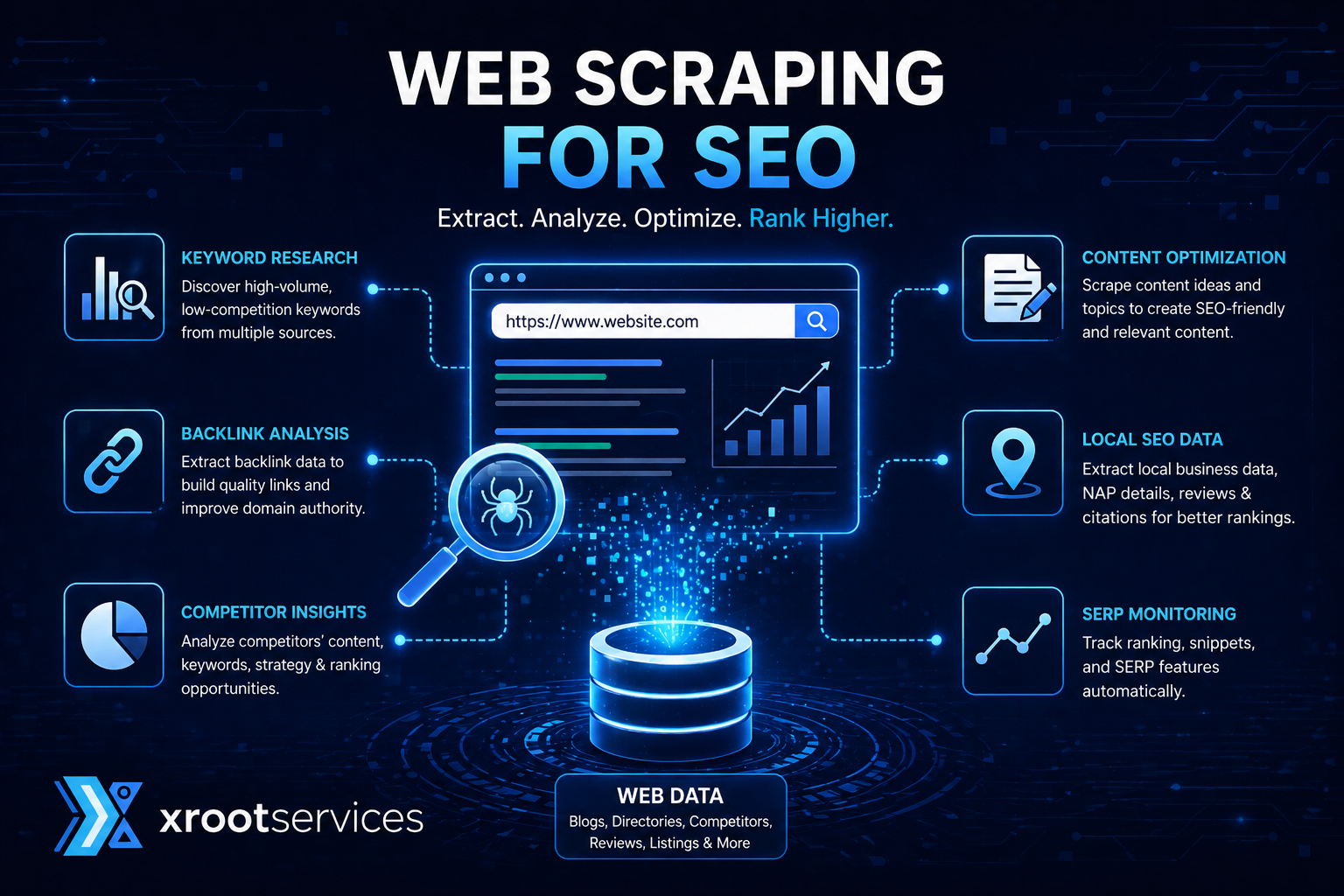
Competitor Keyword Analysis

Understanding which keywords are working and which are not is a vital part of the SEO practice, because no matter how good your content is, if you have stuffed the keywords people aren’t searching, it’s nothing but a waste of time.

And nobody can stress about it more than an experienced SEO expert.

Keywords are the main reason why SEO actually exist and works for so many people.

But in today’s highly competitive era, understanding and analyzing which keywords to use and on which competitors are leveraging, it is very important for you to start using scraping for the same. As having keywords and making content is no longer about instincts or guesswork, it’s a process. With SEO scraping, you can skip the manual research part and have the titles, metadata and headers of your competitors in just minutes, so that you can start analyzing and making strategies rather than just searching for keywords.

Real-Time Rank Tracking

Today, time isn’t just the passing hours; it’s a weapon. As we all know, knowledge is power, and today, whoever can compete with the times is powerful.

Sounds dramatic, but it’s true.

With websites ranking and deranking in minutes, and search results could be totally different as per the hour or the place, it is important for us to understand that the old SEO tools are really old and incompetent in today’s world.

Having real-time information about your websites with respect to thousands of keywords is the new standard by which someone can understand the performance of their websites or content, which the one who waits for a few hours for their tools’ data to be updated is playing catch-up in the race.

Be Smart and Try the smarter way to rank monitoring with SEO Scraping.

Backlink Auditing and Prospecting

The Internet is a web; there are many links connected with one thing, and one thing is connected with many others. But as the digitalization increases, this web is turned into a trap of links, backlinks, websites, and traffic that, if someone actually tries to find something, such as how many backlinks a competitor created, or how many websites are linked back to their site, then it would take days, if not weeks, and still most people won’t get all the links.

Well, that’s the drawback of this world: we try to compete with things that are created to work for us.

The main reason so many SEO experts aren’t ready to adapt to AI or scraping because they think it will make their skills incompetent, but actually, it will increase their productivity to the next level.

Scraping can help you to get all the websites that are linked to your competitor’s website. You can understand their strategy when you understand where their traffic is coming from and where they are getting the leads. In addition to that, you can also check stuff like “Domain Authority” and “Page Relevance”, so you can build an outreach list for your own link-building strategy.

Monitoring Core Web Vitals

Today, as things are getting faster and faster, people are starting to get impatient after a second. And in that scenario, if your website loads even a second later than your competitor, you are losing the customers and clients on the table.

Well, no worries with web scraping, you can analyze all your competitor’s website everyday with just a few tabs, from the page loading speed to image optimization and script usage, to understand where you are actually lacking and in what niche your sites need improvement to make it user friendly.

Because let’s be honest, you might be having the coolest site on the internet, but what’s the use if people skip it because of the waiting time, because today, what matters isn’t having things perfect but having it fast.

Try web scraping, make things faster than you can ever think.

FAQ

Q1. What is SEO Scraping?

SEO Scraping, which is also known as Search Engine Scraping, is a process through which data like URLs, metadata, descriptions and keywords can be extracted from the search engine’s results.

Q2. Is Web Scraping legal in 2026?

Web scraping is always legal, as it’s not the process that is wrong; web scraping is the main reason that so many AI came into existence, but what is wrong is accessing something unauthorized or someone’s personal information when the ToS clearly states against it. So yes, web scraping is legal, but the developer’s intent can be questionable.

Q3. Will AI replace SEO?

AI is created to help the work of the human, there algorithms can help us sort the data faster while retaining the high quality, but there is no such visual future of AI outsmarting the experienced SEO strategist in any way. It can prove to be a good help for them, but cannot replace them in the near future.

Q4. Can I do SEO myself?

Absolutely, if your business website is small, you can do its SEO yourself if you know the foundational rules for the same, like trending keywords, understanding how the algorithm works for the platform and by creating good quality and knowledge-driven content.

Q5. Is Web Scraping free?

Yes, it is for the most part. If you are a business who wanted to scrape a small amount of data, then you can easily scrape it from the free websites or extensions like Webscraper.io or Instant Data Scraper. But if your business needs to have a large amount of data, then there are companies that provide scraping services.
Like XRootServices, which provides web scraping services at a very reasonable rate.

Leave a Comment

Your email address will not be published. Required fields are marked *