



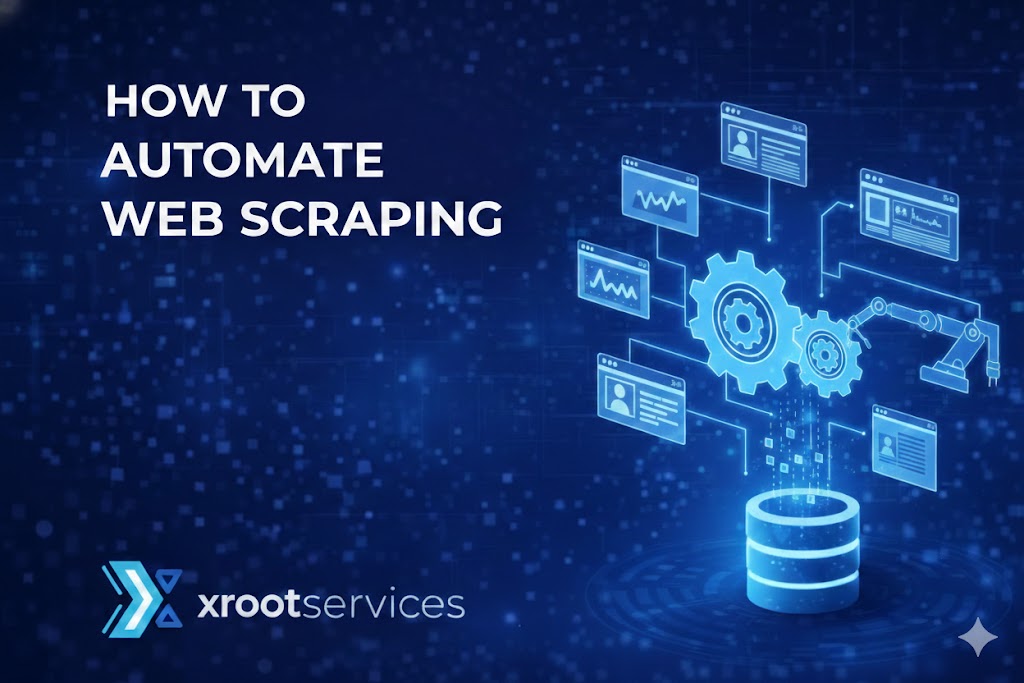
How To Automate Web Scraping
In today’s modern world, data isn’t collected; it is harvested with millions and millions of pages and countless platforms. As we are stepping forward in 2026, the quantity of data in the marketplace is becoming massive, where normal scraping scripts are failing to catch up, and manual scraping has become a nightmare of the past, with burning eyes and continuous working finger but the data is never finishing.
To deal with this amount of data, which can be updated in just a few hours, businesses are choosing automated web scraping as a technique by which the extraction of data will be uninterrupted and will be without any human involvement.
Impressive right? If you also want to learn how to create your own automated web scraper, then you are on the right blog. In this blog, we will cover everything from basic knowledge of automated web scrapers to advanced-level issues it can solve for businesses.
Table of Contents
1. Why Automation is the New Standard of Web Scraping
2. Basic Architecture of Automated Scraper
3. Future of Automated Web Scraping
4. Conclusion
Automation, the New Standard of Web Scraping
When we start something or buy something, the first thing that comes to mind is “why”, why do I need it, why do I have to buy it, is it important, and the question goes on and on and on.
But when we are planning to grow the business or create something new, that “why” actually gets overshadowed by the hustle of creation, testing errors, and so many other things, and we just forget why we are doing it. And the same thing comes to the new technologies and tools, too. Why do we need it?
So in this section, we will discuss why automation has become the new standard of web scraping. Why automation become so important for web scraping?
There are mainly three major reasons because of which automation became the jack of web scraping that every business wants in today’s success and profit-chasing market. So let’s discuss these reasons.
Scalability
Everyone wanted to grow, either it is you or your business, but with growth comes the burden that someone needs to carry, and trust me, scrapers are the ones who can carry that heavy weight of expansion, from which you were just extracting a normal amount of information till now. But the script flips when automation comes to the picture; now you are scaling without any worry of data collection, as an automated scraper can scrape thousands of pages per minute, making it impossible for a normal crawler.
Consistency
While web scraping has been used for hundreds of years now, there is needs for maintenance every now and then, the scripts breaks and the flow of data extraction comes to an unexpected halt. The problem could be as minute as the alteration in the structure of the website you were scraping, which caused it. This data inconsistency was bearable back then, but today, when your every minute counts in this impulsively competitive market, you can’t afford the inconsistency of data extraction just because of a minute problem. Smart web automation scrapers can evolve to the mundane changes automatically so that the process will be uninterrupted and data will always consistent all the time.
Cost-Efficiency
While the automation sounds expensive and very costly, nothing could be further from the truth. Yeah, it’s true that you need to spend some bucks to set up the automation and most probably have to engage a resource in the initial stage, but after it is set up, the amount of data you can scrape will be worth it for you. The cost per record will be much cheaper than an in-house web scraper as well.
In short, we can say that adopting automation for your web scraper or having the automation services is something that keeps you in a win-win situation, where you get a huge amount of data and that too in cost much lesser than web scraping.
Basic Architecture of Automated Scraper
Now that we have discussed about why a business needs web automation in today’s marketplace. Let’s get into more important stuff, like what the architecture of an automated scraper.
In this part of the blog, we will discuss mainly about the architecture of an automated web scraper, which consists of different layers and can be structured accordingly to have a healthy and fast web scraper.
So, here are the architectural layers of an automated web scraper.
The Request Layer (Engine)
As the name suggest this is the layer where scrape sends requests to the server. In simple language, we can say that in this stage, the scraper interacts or asks the server about the information it requires. The roles and responsibilities of these layers are as follows:
Support
This layer is mainly responsible for 3 support or the basic 3 steps which should be performed successfully for further operations, these steps are (1) sending HTTP request is right structure to ensure that there is no failure (2) the extraction for the data parsing is matching with the structure of website (3) the place where the data needs to stored is valid.
Headless Browsing
There are tools like **Playwright** or **Puppeteer** that are used to ensure that the data is scraped correctly and the traditional libraries like “request” can’t see it, as there are some of the JavaScript heavy sites whose process of data extraction could be a bit tricky what is more tricky is not getting leaving the digital footprints while doing it, and it’s the main job of headless browser.
The Proxy & Identity Layer (The Mask)
Today’s websites are very sensitive towards the bots, or we can also say that these website security systems get triggered really easily when there are suddenly a lot of requests, and especially from the same IP address.
What this layer does is it ensures that the websites won’t be able to figure out that there is any scraper or crawler that is sending any request to the server; in other words, it masks the identity of a bot into a normal human or manual request. Below are the technique which help in hiding the identity.
Rotating Residential Proxies
This technique is used when the scraper rotates the real proxies of different regions after a certain amount of time or a certain number of requests, so that the request or scraper seems genuine rather than a bot that is giving a lot of requests at the same time.
Mobile Proxies
Social media platforms and community forums are the platforms where normally traffic comes from mobile users, and these platforms also prioritize mobile traffic as well, so these scrapers use mobile proxies to scrape these platforms for better performance.
By using the above techniques, the scraper can successfully disguise its identity of the scraper to ensure there are no digital footprints left for suspicion.
The Parsing Layer (The Brain)
This is the third and one of the most important layers for the automated web scraping, as this layer will process the data and structure it accordingly. Once the data from the website is scraped, whether it is an HTML website or a JavaScript-heavy website, after the data is scraped the data needs to be stored in a structured format for better analysis. For which there are mainly two methods for the same, let’s explore them.
Regex and XPAth
This is a traditional method of structuring the data after scraping. The use of regex or XPath is used when there website are in a fixed layout, or the same website is being scraped multiple times.
AI-Native Parsing
Today’s AI bots, which scrape the latest data automatically, mainly uses this method in this method the scraper or bot is self evolving or we can say it is self adopting, so even when the format or the structure of the data alters still the data extraction and conversion of that data into a structured for will be uninterrupted.
While both methods sound impressive, it works efficiently only when the use case is right. For example, if the website is dynamic, you shouldn’t be using XPath or regex because it will halt the scraping process, even for minor changes. On the other hand, if you use a self-evolving scraper on the static website, it will be like complicating things for a basic result.
That’s why it is important for you to understand your targeted website and then choose the parsing process accordingly.
The Storage Layer (The Warehouse)
After structuring the data, it needs to be stored. This is the layer that is responsible for the successful storage of the data. This is the last layer of the architecture, because after everything is the data is not stored or retained, then all the efforts will be wasted.
There are mainly two locations where the data is stored after it is scraped from the internet. Let’s go through both the storage locations, with what are their advantages are and what not.
Cloud Warehouses
Cloud databases like Snowflake, Google BigQuery or Amazon S3. These are databases that can be opened on different devices and can have a synced reflection on the data alteration, while these databases store the data in a structured format.
NoSQL Databases
On the other hand, there are databases like MongoDB or Elasticsearch, which are well known example for NoSQL databases, and these databases can hold unstructured as well as structured data. These databases are flexible and are widely used because of their acceptance in semi-structured and unstructured databases.
Future of Automated Web Scraping
Everything we create or convert into, we always thinks about future, the first thing ask to ourself that will this be sustainable for future if we switch to this technology, because adopting new tech or practice means abandoning old, which not only require time and patience but also creates a considerable amount of chaos in the company, which you don’t want to go through again and again.
Generative AI & Self-Healing Scrapers
As the market is becoming more and more competitive, having traditional and manually holding web scrapers is like bringing a vintage, broken car to the Formula One race. In the near future, using manually dependent scrapers will result in loss of customers as well as profit, because you won’t be able to afford to have outdated data.
With a smart automated web scraping tool, which has the ability to adopt on the changes of the websites for scraping, so the process of data extraction will never be interrupted, is the future of web scraping, and without an automated web scraper, this won’t be possible.
Zero-Code Natural Language Extraction
Now people don’t want to read blogs and articles when there are bots like ChatGPT, which can scrape the relevant articles according to your requirement and provides it to you in seconds. In a few years, this will be the new standard for every chatbot. And with an increase in the use of chatbot there will be a business model for it as well, where businesses can get the data for their competitors with just a single prompt.
Be smart and take the step towards the future when it’s still a future.
Edge Scraping & Decentralized Networks
As there are applications which tells not just about the present condition of the stock, but it also provide information about which stock gets higher or lower?
Well, stock market is just a starting, in half a decade all the field will be having the an smart AI bot which can analyze the present situation so that it can predict the near future, and for that these bots will require constant and non stop supply of data to give the real-time predict and no web scraper will be able to fulfil that requirement only a automated web scraper can supply constant and uninterrupted data.
Conclusion
After understanding the ground reality of the market of today and what could be the market of tomorrow, we can say that automating the web scraping isn’t a choice for businesses; it became the obligation that businesses need to adopt as soon as possible, no matter what.
Automation isn’t just the solution of consistency of data, but it is a foundation step towards a brighter future of web scrapers where web scraper will have their own identity and importance rather than being overshadowed by a few chatbots.
To know more about why does businesses needs web scraping to lead the market, this blog is for you. Why Businesses Need Web Scraping.